
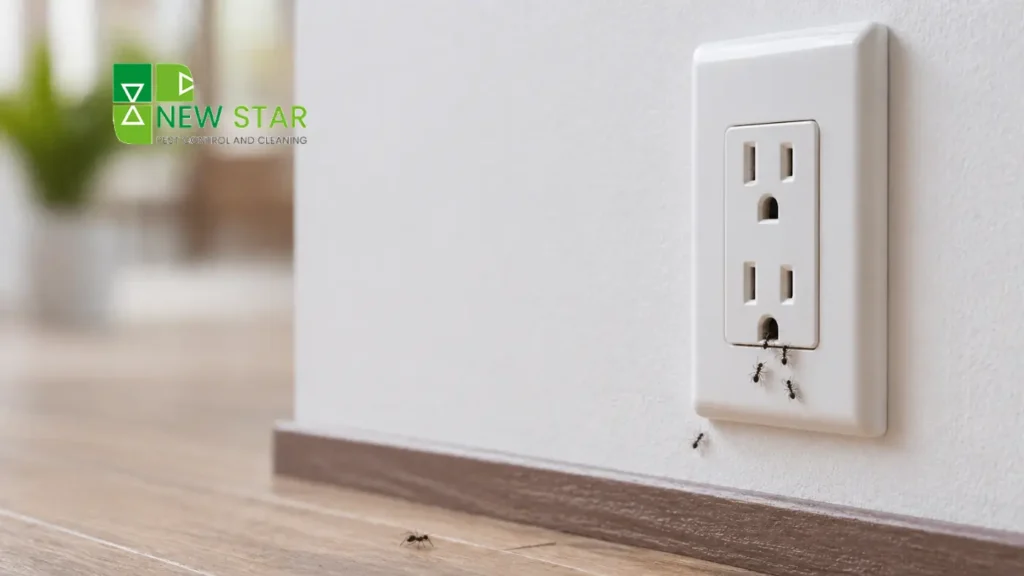
Most homeowners associate ant infestations with kitchens, pantries, or garden edges. So when a steady trail of ants appears near a wall socket, the reaction is usually confusion, followed quickly by concern. And rightly so.
Ants nesting within electrical systems is a well-documented pest problem that carries genuine risks to property, electrical infrastructure, and, in serious cases, occupant safety. If you have noticed activity near your outlets, this guide covers the causes, consequences, and the most effective solutions available.
Why Are Ants Attracted to Electrical Outlets?
Ants are not randomly wandering into your walls — they are responding to specific environmental signals.
Heat from electrical wiring: Outlet casings and wiring emit low-level, consistent warmth. For many ant species, this mimics the conditions of a naturally insulated nest. Once a forager identifies the location and marks it with a pheromone trail, the colony follows rapidly.
Hollow wall cavities: Buildings contain concealed wall spaces that serve as thoroughfares for ant colonies. These allow insects to travel significant distances entirely out of sight. The outlet is frequently just the visible exit point of a much larger, hidden network.
Moisture accumulation: Condensation, minor leaks, or poor insulation can create damp pockets within wall cavities. Carpenter ants and odorous house ants actively seek these environments for nesting. Where warmth and moisture coexist, colonies establish quickly.
The Risks You Cannot Afford to Ignore
Ants coming from electrical outlet spaces present risks that go well beyond inconvenience.
- Damage to wiring insulation: Ants gnaw through protective wire coatings, exposing live conductors and creating a genuine risk of short circuits or electrical fires
- Rapid colony expansion: A scouting trail can develop into a mature satellite colony within weeks
- Ineffectiveness of surface treatments: Consumer sprays do not reach wall-cavity colonies and can, with certain species, accelerate the spread
- Secondary structural damage: Organic debris carried into nest sites can contribute to moisture retention and mould within wall structures
How to Eliminate the Infestation: A Step-by-Step Approach
Step 1: Never Spray Near the Outlet
The most important rule: do not apply any liquid pesticide or aerosol into or around an electrical outlet. Even with the circuit isolated, chemical residues can degrade wiring or corrode contacts. This applies to DIY treatments and untrained operators equally.
Step 2: Identify the Species Accurately
Correct identification is the foundation of effective treatment. Different species require entirely different control methods.
- Pharaoh ants: Small, pale yellow; prone to colony budding when disturbed by repellent products
- Carpenter ants: Large, often black; associated with moisture-damaged timber and structural concerns
- Crazy ants: Known for their particular attraction to electrical equipment and wiring spaces
- Fire ants: Reddish-brown; aggressive, requiring specialised bait formulations
If identification is uncertain, consult a licensed professional before proceeding.
Step 3: Deploy Targeted Bait Strategically
Gel-based ant baits and enclosed bait stations are the most effective treatment for wall-cavity infestations. Worker ants consume the bait and carry it back to the colony, where it reaches the queen. Without the queen, the colony collapses. Place bait along the active foraging trail—not inside the outlet—and allow it to work undisturbed for a minimum of ten to fourteen days.
Step 4: Seal All Entry Points After Treatment
Once the colony is eliminated, seal access points using electrically safe caulk or low-expansion foam sealant. Extend the inspection to pipe entry points, skirting board gaps, foundation cracks, and external wall penetrations. Preventing re-entry is as important as the initial treatment.
Step 5: Resolve the Underlying Cause
Sustainable results require identifying what made the location attractive — a moisture source, a nearby external colony, or structural features that facilitate access. Addressing the root cause is what separates a permanent solution from a recurring problem.
Expert Recommendations from Pest Professionals
Lead with bait, not repellent: For species such as pharaoh ants, repellent products trigger colony budding — a survival mechanism in which one colony divides into multiple independent units. The infestation multiplies rather than retreats.
Allow sufficient treatment time: Bait transfers from the worker ant to the queen gradually. Removing stations prematurely because activity appears unchanged is one of the most common reasons treatments fail.
Eliminate moisture contributors: Any damp conditions near the affected wall — from plumbing, condensation, or drainage — should be rectified alongside the pest treatment. Moisture is as much a driver of infestation as warmth or food.
Common Errors That Undermine Treatment
| Error | Consequence |
| Spraying into or near outlets | Electrical hazard; wiring degradation |
| Using repellent near bait stations | Prevents colony-level elimination |
| Treating surface trails only | The colony continues unaffected |
| Removing bait too early | The queen survives; colony regenerates |
| Failing to seal entry points | Rapid re-infestation |
When to Call a Professional
There are situations where professional ant pest removal is the only practical course of action:
- Infestations persisting beyond two to three weeks despite treatment attempts
- Ant activity across multiple outlets or building zones
- Presence of carpenter ants, which may indicate underlying structural timber damage
- Commercial or multi-occupancy premises requiring a comprehensive inspection
Licensed technicians deploy professional-grade, non-repellent formulations designed to penetrate wall cavities safely. They also locate satellite colonies and external entry points — elements that are beyond the scope of standard DIY assessment.
Pest Control in the UAE: Regional Considerations
Year-round heat, high humidity, and rapid urban development across the UAE sustain pest pressures that do not ease with seasonal change. Ant pest control Dubai providers manage infestations across residential towers and large commercial facilities daily. Pest Control Dubai professionals have adapted their protocols specifically for internal infestations within electrical infrastructure, as continued construction activity displaces established colonies into occupied buildings.
In the northern emirates, Pest Control Sharjah operators consistently report wall-cavity infestations in older residential stock where infrastructure creates ready access. Ant control has advanced significantly, with licensed operators routinely deploying non-repellent gel bait systems and targeted residual treatments calibrated to local species and conditions.
Frequently Asked Questions
Are ants coming from electrical outlets a fire hazard?
Yes. Ants that chew through wire insulation expose live conductors, which can cause short circuits and electrical fires. Any confirmed activity within electrical systems should be treated as a priority.
Is it safe to apply insecticide near an electrical outlet?
No. Liquid insecticides and aerosols should never be applied to or around outlets. Bait stations placed along the foraging trail from the outlet are the correct method.
Why does the infestation return after treatment?
Recurrence indicates that the queen was not eliminated, satellite colonies remain active within the wall, or entry points were not sealed post-treatment. A professional inspection will identify which factor applies.
How long before the bait treatment shows results?
Colony-level elimination typically requires ten to fourteen days. In larger colonies, up to three weeks. Consistent bait availability throughout this period is essential.
Take Action Before Ants Spread Further
An ant trail near a wall socket is rarely as simple as it appears. What registers as a minor surface problem is, in most cases, the visible indicator of a colony operating within your building’s infrastructure—one that poses measurable risks to your electrical systems and property.
A properly managed infestation does not return, and that is the standard worth holding to. Pet-friendly pest control in Dubai is more than just a service. It is a responsible choice for homeowners who want effective results without harmful side effects. By combining expert solutions with preventive care, you can create a space where both you and your pets can live comfortably. If pests are becoming a concern, now is the time to act. Choose a safer, smarter solution that protects what matters most.
Protect your home without risking your pet’s safety. Call 0588672492 today for safe and pet-friendly pest control solutions.